 Add to Chrome
 Add to Firefox
 Add to Edge
Parallel-Probe: Towards Efficient Parallel Thinking via 2D Probing
Feb 03, 2026
Parallel thinking has emerged as a promising paradigm for reasoning, yet it imposes significant computational burdens. Existing efficiency methods primarily rely on local, per-trajectory signals and lack principled mechanisms to exploit global dynamics across parallel branches. We introduce 2D probing, an interface that exposes the width-depth dynamics of parallel thinking by periodically eliciting intermediate answers from all branches. Our analysis reveals three key insights: non-monotonic scaling across width-depth allocations, heterogeneous reasoning branch lengths, and early stabilization of global consensus. Guided by these insights, we introduce $\textbf{Parallel-Probe}$, a training-free controller designed to optimize online parallel thinking. Parallel-Probe employs consensus-based early stopping to regulate reasoning depth and deviation-based branch pruning to dynamically adjust width. Extensive experiments across three benchmarks and multiple models demonstrate that Parallel-Probe establishes a superior Pareto frontier for test-time scaling. Compared to standard majority voting, it reduces sequential tokens by up to $\textbf{35.8}$% and total token cost by over $\textbf{25.8}$% while maintaining competitive accuracy.

Prepare Reasoning Language Models for Multi-Agent Debate with Self-Debate Reinforcement Learning
Jan 29, 2026The reasoning abilities of large language models (LLMs) have been substantially improved by reinforcement learning with verifiable rewards (RLVR). At test time, collaborative reasoning through Multi-Agent Debate (MAD) has emerged as a promising approach for enhancing LLM performance. However, current RLVR methods typically train LLMs to solve problems in isolation, without explicitly preparing them to synthesize and benefit from different rationales that arise during debate. In this work, we propose Self-Debate Reinforcement Learning (SDRL), a training framework that equips a single LLM with strong standalone problem-solving ability and the capability to learn from diverse reasoning trajectories in MAD. Given a prompt, SDRL first samples multiple candidate solutions, then constructs a debate context with diverse reasoning paths and generates second-turn responses conditioned on this context. Finally, SDRL jointly optimizes both the initial and debate-conditioned responses, yielding a model that is effective as both a standalone solver and a debate participant. Experiments across multiple base models and reasoning benchmarks show that SDRL improves overall MAD performance while simultaneously strengthening single model reasoning.
RelayLLM: Efficient Reasoning via Collaborative Decoding
Jan 08, 2026Large Language Models (LLMs) for complex reasoning is often hindered by high computational costs and latency, while resource-efficient Small Language Models (SLMs) typically lack the necessary reasoning capacity. Existing collaborative approaches, such as cascading or routing, operate at a coarse granularity by offloading entire queries to LLMs, resulting in significant computational waste when the SLM is capable of handling the majority of reasoning steps. To address this, we propose RelayLLM, a novel framework for efficient reasoning via token-level collaborative decoding. Unlike routers, RelayLLM empowers the SLM to act as an active controller that dynamically invokes the LLM only for critical tokens via a special command, effectively "relaying" the generation process. We introduce a two-stage training framework, including warm-up and Group Relative Policy Optimization (GRPO) to teach the model to balance independence with strategic help-seeking. Empirical results across six benchmarks demonstrate that RelayLLM achieves an average accuracy of 49.52%, effectively bridging the performance gap between the two models. Notably, this is achieved by invoking the LLM for only 1.07% of the total generated tokens, offering a 98.2% cost reduction compared to performance-matched random routers.
ImAgent: A Unified Multimodal Agent Framework for Test-Time Scalable Image Generation
Nov 14, 2025Recent text-to-image (T2I) models have made remarkable progress in generating visually realistic and semantically coherent images. However, they still suffer from randomness and inconsistency with the given prompts, particularly when textual descriptions are vague or underspecified. Existing approaches, such as prompt rewriting, best-of-N sampling, and self-refinement, can mitigate these issues but usually require additional modules and operate independently, hindering test-time scaling efficiency and increasing computational overhead. In this paper, we introduce ImAgent, a training-free unified multimodal agent that integrates reasoning, generation, and self-evaluation within a single framework for efficient test-time scaling. Guided by a policy controller, multiple generation actions dynamically interact and self-organize to enhance image fidelity and semantic alignment without relying on external models. Extensive experiments on image generation and editing tasks demonstrate that ImAgent consistently improves over the backbone and even surpasses other strong baselines where the backbone model fails, highlighting the potential of unified multimodal agents for adaptive and efficient image generation under test-time scaling.
Beyond English: Toward Inclusive and Scalable Multilingual Machine Translation with LLMs
Nov 10, 2025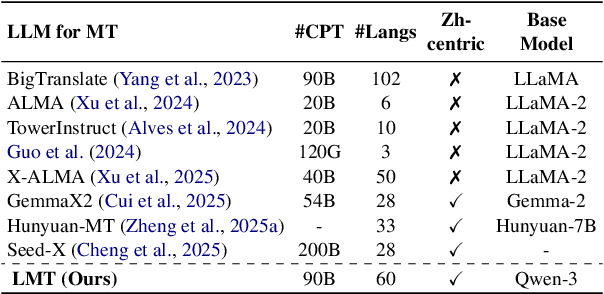
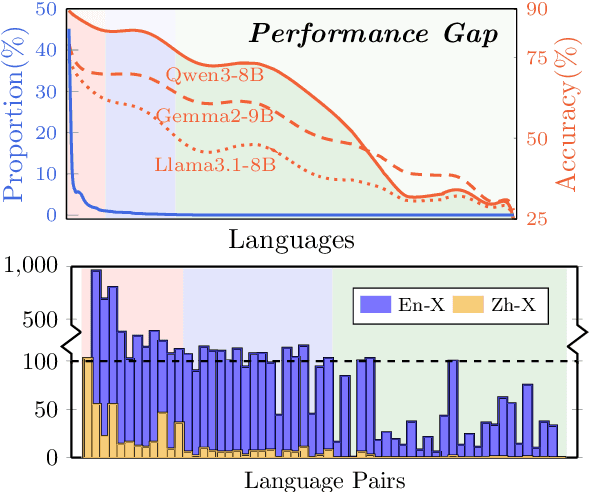
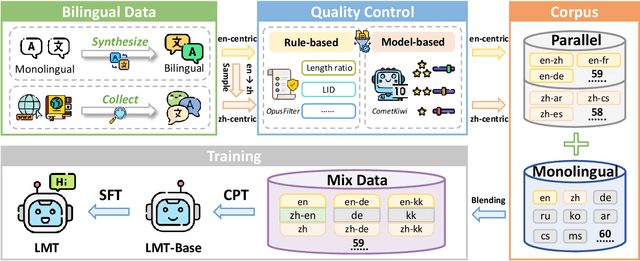
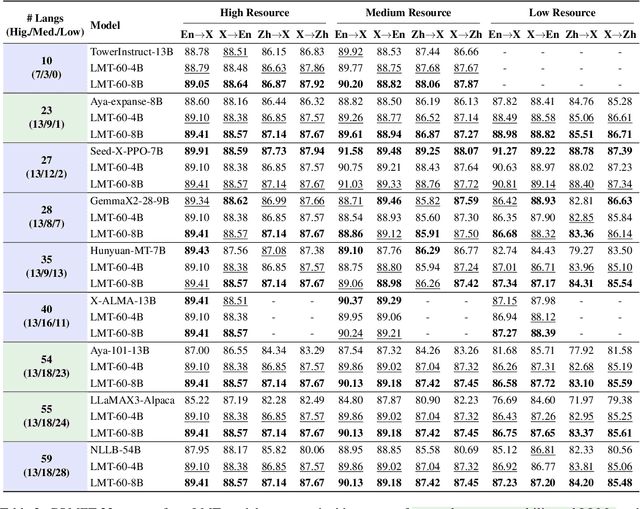
Large language models have significantly advanced Multilingual Machine Translation (MMT), yet the broad language coverage, consistent translation quality, and English-centric bias remain open challenges. To address these challenges, we introduce \textbf{LMT}, a suite of \textbf{L}arge-scale \textbf{M}ultilingual \textbf{T}ranslation models centered on both Chinese and English, covering 60 languages and 234 translation directions. During development, we identify a previously overlooked phenomenon of \textbf{directional degeneration}, where symmetric multi-way fine-tuning data overemphasize reverse directions (X $\to$ En/Zh), leading to excessive many-to-one mappings and degraded translation quality. We propose \textbf{Strategic Downsampling}, a simple yet effective method to mitigate this degeneration. In addition, we design \textbf{Parallel Multilingual Prompting (PMP)}, which leverages typologically related auxiliary languages to enhance cross-lingual transfer. Through rigorous data curation and refined adaptation strategies, LMT achieves SOTA performance among models of comparable language coverage, with our 4B model (LMT-60-4B) surpassing the much larger Aya-101-13B and NLLB-54B models by a substantial margin. We release LMT in four sizes (0.6B/1.7B/4B/8B) to catalyze future research and provide strong baselines for inclusive, scalable, and high-quality MMT \footnote{\href{https://github.com/NiuTrans/LMT}{https://github.com/NiuTrans/LMT}}.
VOGUE: Guiding Exploration with Visual Uncertainty Improves Multimodal Reasoning
Oct 01, 2025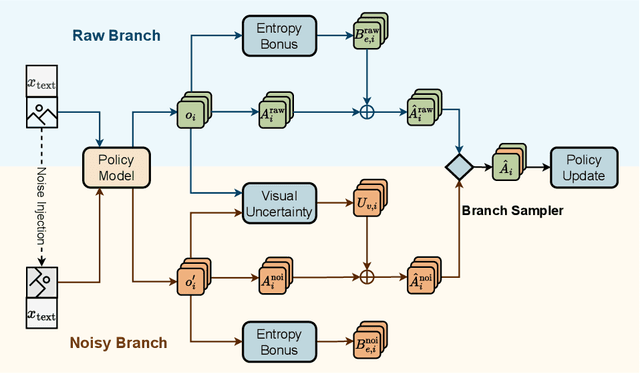
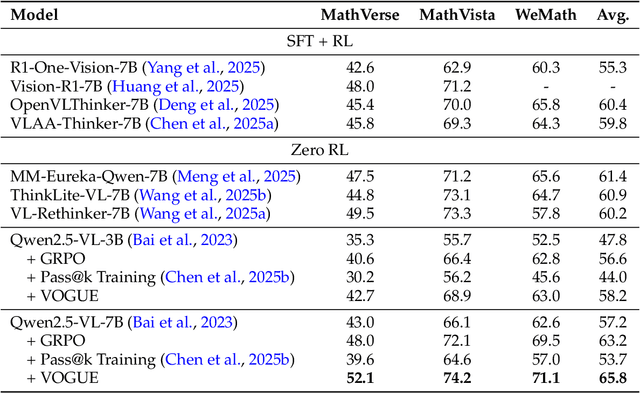
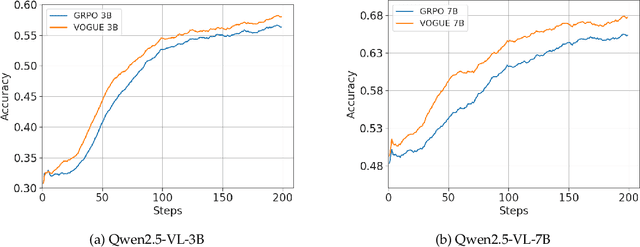
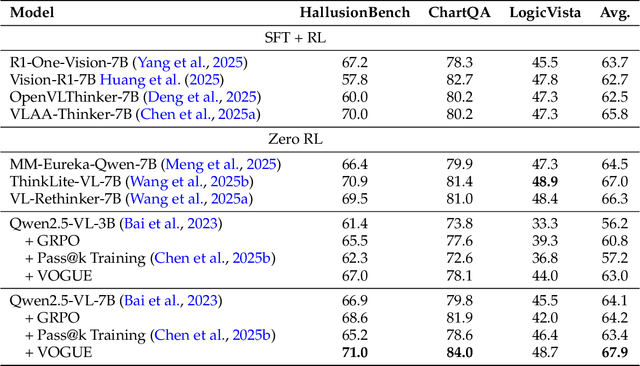
Reinforcement learning with verifiable rewards (RLVR) improves reasoning in large language models (LLMs) but struggles with exploration, an issue that still persists for multimodal LLMs (MLLMs). Current methods treat the visual input as a fixed, deterministic condition, overlooking a critical source of ambiguity and struggling to build policies robust to plausible visual variations. We introduce $\textbf{VOGUE (Visual Uncertainty Guided Exploration)}$, a novel method that shifts exploration from the output (text) to the input (visual) space. By treating the image as a stochastic context, VOGUE quantifies the policy's sensitivity to visual perturbations using the symmetric KL divergence between a "raw" and "noisy" branch, creating a direct signal for uncertainty-aware exploration. This signal shapes the learning objective via an uncertainty-proportional bonus, which, combined with a token-entropy bonus and an annealed sampling schedule, effectively balances exploration and exploitation. Implemented within GRPO on two model scales (Qwen2.5-VL-3B/7B), VOGUE boosts pass@1 accuracy by an average of 2.6% on three visual math benchmarks and 3.7% on three general-domain reasoning benchmarks, while simultaneously increasing pass@4 performance and mitigating the exploration decay commonly observed in RL fine-tuning. Our work shows that grounding exploration in the inherent uncertainty of visual inputs is an effective strategy for improving multimodal reasoning.
CDE: Curiosity-Driven Exploration for Efficient Reinforcement Learning in Large Language Models
Sep 11, 2025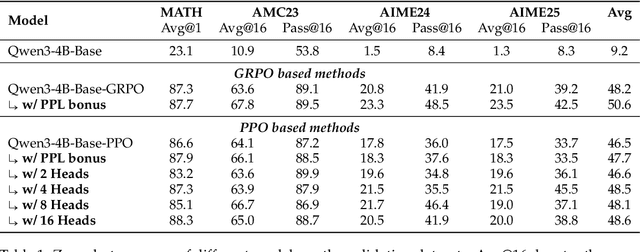
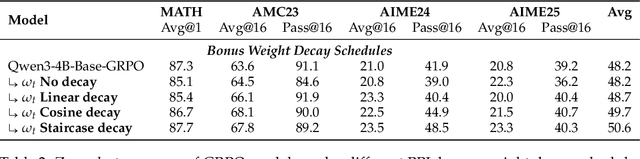
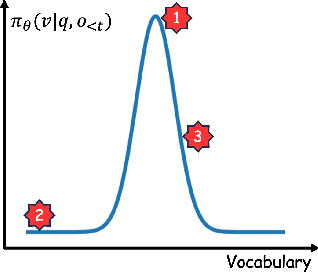
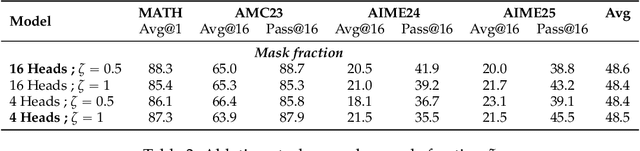
Reinforcement Learning with Verifiable Rewards (RLVR) is a powerful paradigm for enhancing the reasoning ability of Large Language Models (LLMs). Yet current RLVR methods often explore poorly, leading to premature convergence and entropy collapse. To address this challenge, we introduce Curiosity-Driven Exploration (CDE), a framework that leverages the model's own intrinsic sense of curiosity to guide exploration. We formalize curiosity with signals from both the actor and the critic: for the actor, we use perplexity over its generated response, and for the critic, we use the variance of value estimates from a multi-head architecture. Both signals serve as an exploration bonus within the RLVR framework to guide the model. Our theoretical analysis shows that the actor-wise bonus inherently penalizes overconfident errors and promotes diversity among correct responses; moreover, we connect the critic-wise bonus to the well-established count-based exploration bonus in RL. Empirically, our method achieves an approximate +3 point improvement over standard RLVR using GRPO/PPO on AIME benchmarks. Further analysis identifies a calibration collapse mechanism within RLVR, shedding light on common LLM failure modes.
Parallel-R1: Towards Parallel Thinking via Reinforcement Learning
Sep 09, 2025Parallel thinking has emerged as a novel approach for enhancing the reasoning capabilities of large language models (LLMs) by exploring multiple reasoning paths concurrently. However, activating such capabilities through training remains challenging, as existing methods predominantly rely on supervised fine-tuning (SFT) over synthetic data, which encourages teacher-forced imitation rather than exploration and generalization. Different from them, we propose \textbf{Parallel-R1}, the first reinforcement learning (RL) framework that enables parallel thinking behaviors for complex real-world reasoning tasks. Our framework employs a progressive curriculum that explicitly addresses the cold-start problem in training parallel thinking with RL. We first use SFT on prompt-generated trajectories from easier tasks to instill the parallel thinking ability, then transition to RL to explore and generalize this skill on harder problems. Experiments on various math benchmarks, including MATH, AMC23, and AIME, show that Parallel-R1 successfully instills parallel thinking, leading to 8.4% accuracy improvements over the sequential thinking model trained directly on challenging tasks with RL. Further analysis reveals a clear shift in the model's thinking behavior: at an early stage, it uses parallel thinking as an exploration strategy, while in a later stage, it uses the same capability for multi-perspective verification. Most significantly, we validate parallel thinking as a \textbf{mid-training exploration scaffold}, where this temporary exploratory phase unlocks a higher performance ceiling after RL, yielding a 42.9% improvement over the baseline on AIME25. Our model, data, and code will be open-source at https://github.com/zhengkid/Parallel-R1.
One Size Does Not Fit All: A Distribution-Aware Sparsification for More Precise Model Merging
Aug 08, 2025Model merging has emerged as a compelling data-free paradigm for multi-task learning, enabling the fusion of multiple fine-tuned models into a single, powerful entity. A key technique in merging methods is sparsification, which prunes redundant parameters from task vectors to mitigate interference. However, prevailing approaches employ a ``one-size-fits-all'' strategy, applying a uniform sparsity ratio that overlooks the inherent structural and statistical heterogeneity of model parameters. This often leads to a suboptimal trade-off, where critical parameters are inadvertently pruned while less useful ones are retained. To address this limitation, we introduce \textbf{TADrop} (\textbf{T}ensor-wise \textbf{A}daptive \textbf{Drop}), an adaptive sparsification strategy that respects this heterogeneity. Instead of a global ratio, TADrop assigns a tailored sparsity level to each parameter tensor based on its distributional properties. The core intuition is that tensors with denser, more redundant distributions can be pruned aggressively, while sparser, more critical ones are preserved. As a simple and plug-and-play module, we validate TADrop by integrating it with foundational, classic, and SOTA merging methods. Extensive experiments across diverse tasks (vision, language, and multimodal) and models (ViT, BEiT) demonstrate that TADrop consistently and significantly boosts their performance. For instance, when enhancing a leading merging method, it achieves an average performance gain of 2.0\% across 8 ViT-B/32 tasks. TADrop provides a more effective way to mitigate parameter interference by tailoring sparsification to the model's structure, offering a new baseline for high-performance model merging.
Learning to Reason via Mixture-of-Thought for Logical Reasoning
May 21, 2025Human beings naturally utilize multiple reasoning modalities to learn and solve logical problems, i.e., different representational formats such as natural language, code, and symbolic logic. In contrast, most existing LLM-based approaches operate with a single reasoning modality during training, typically natural language. Although some methods explored modality selection or augmentation at inference time, the training process remains modality-blind, limiting synergy among modalities. To fill in this gap, we propose Mixture-of-Thought (MoT), a framework that enables LLMs to reason across three complementary modalities: natural language, code, and a newly introduced symbolic modality, truth-table, which systematically enumerates logical cases and partially mitigates key failure modes in natural language reasoning. MoT adopts a two-phase design: (1) self-evolving MoT training, which jointly learns from filtered, self-generated rationales across modalities; and (2) MoT inference, which fully leverages the synergy of three modalities to produce better predictions. Experiments on logical reasoning benchmarks including FOLIO and ProofWriter demonstrate that our MoT framework consistently and significantly outperforms strong LLM baselines with single-modality chain-of-thought approaches, achieving up to +11.7pp average accuracy gain. Further analyses show that our MoT framework benefits both training and inference stages; that it is particularly effective on harder logical reasoning problems; and that different modalities contribute complementary strengths, with truth-table reasoning helping to overcome key bottlenecks in natural language inference.